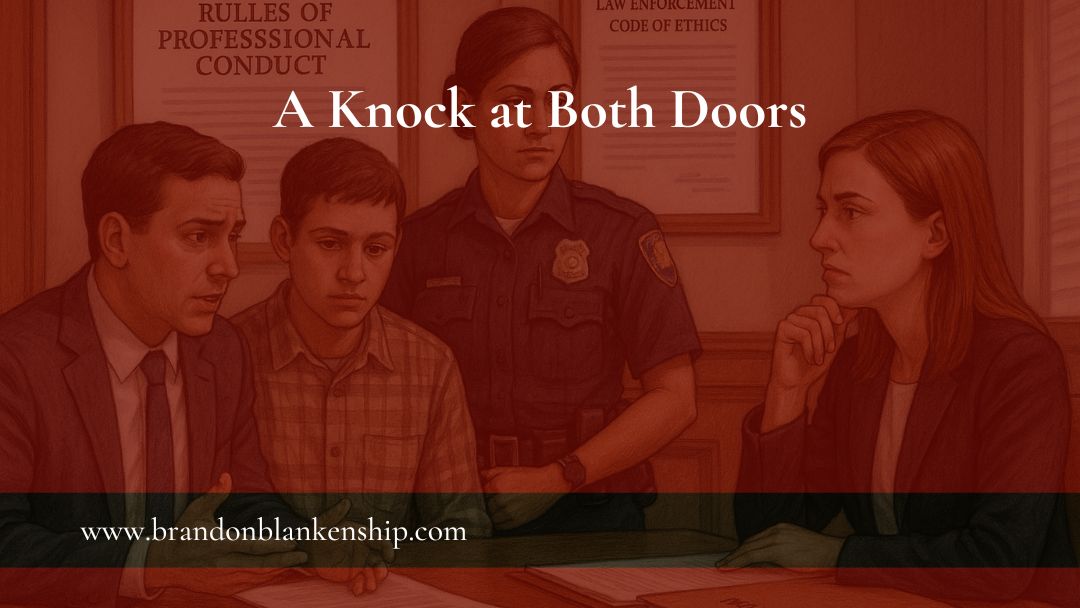
This post is used as source material for Prof. Blankenship’s courses.
Setting: A small Southern town. The community is tight-knit, the courthouse just a few blocks from the police station, and reputations carry long memories.
Characters:
- Officer Dana Reyes, a patrol officer known for being community-minded but under pressure from her department to “show results.”
- Attorney Malcolm Ward, a defense attorney with a growing practice, sharp-minded, idealistic, but burdened by student loans and a partner who wants him home more.
- Attorney Sheila Marks, a public interest lawyer who once clerked for a federal judge, committed to protecting civil rights.
- ADA Jordan Clay, a local assistant district attorney with ambitions for a judgeship, known for being measured, politically savvy, and hard to read.
- Eric Nolan, a 17-year-old high school senior with no prior record, whose older brother is serving time for gang-related activity.
Part I: The Arrest
Officer Reyes pulls over a vehicle driven by Eric Nolan. A cracked taillight gives the legal pretext. In the car, she finds a paper bag under the seat with several plastic baggies and a scale. Eric claims the car is his brother’s, recently borrowed. There is no smell of drugs, no observed transactions, no record on Eric. But the items suggest potential intent to distribute.
Reyes hesitates.
She remembers the Law Enforcement Ethical Frame, particularly its command to "never engage in acts of corruption or bribery, nor will I condone such acts by other police officers" and to "enforce the law courteously and appropriately without fear or favor."
She’s heard rumors that supervisors want higher drug charges to justify a grant renewal. If she calls in the K9 unit and gets a false alert, it could provide cause for a deeper search—standard practice, but ethically dubious here. She opts not to fabricate any probable cause but books Eric on suspicion based on what she found, documenting everything cleanly.
But when she files the report, her sergeant pulls her aside and says, “We need to be a little more aggressive on this if we want that Department of Justice funding next year. Write it up like he made a sudden move to hide something.”
Reyes must decide whether to amend her report.
Part II: The Defense Dilemma
Eric’s mother contacts Attorney Malcolm Ward, who immediately sees a potential case of racial profiling and possibly an illegal search. But as he digs in, he finds that Attorney Sheila Marks, a civil rights lawyer, has already filed a public information request on Reyes’s traffic stops, suspecting a pattern of targeting Black teens for pretextual stops.
Sheila offers to share her data—but with conditions: she wants to co-counsel, and she’s planning to challenge the entire department’s practices through this case, not just get Eric’s charges dropped. She believes the ends (systemic change) justify taking a bold path.
Malcolm knows that the Attorney Ethical Frame is informed by ABA Model Rule 1.2 (Scope of Representation) and Rule 1.7 (Conflict of Interest: Current Clients) that he must act in Eric’s best interest—not in Sheila’s broader advocacy goals. He also worries that a public campaign could harm plea negotiations or even draw unwanted attention that could complicate Eric’s case.
He feels torn. Sheila’s data could be the key to winning the case outright. But he’s not sure if teaming up aligns with his duty to his client, and he wonders whether Sheila’s approach introduces a potential conflict between co-counsels.
He files a motion based on Brady v. Maryland demanding that the prosecution disclose any evidence that is favorable to the defendant and material to either guilty or punishment. Also, he requests a meeting with the local bar’s ethics counsel before deciding.
Part III: The Prosecutor’s Puzzle
The case ends up on ADA Jordan Clay’s desk. She knows Reyes—respected, but not above departmental pressure. She reads the clean report, then notices the timestamp change in a later version of the file. Something was revised. Something small, but possibly material.
Her instincts tell her something’s off.
She also knows Eric’s brother is in prison on her office’s prior prosecution, and the optics of this second case might draw attention.
Jordan faces a three-pronged ethical dilemma:
- Do I disclose to the defense that the officer's report may have been altered?
- Do I dig deeper into Officer Reyes’s history—even if it strains relations with the police department?
- Do I offer a plea deal to avoid public scrutiny and quietly resolve the case, or go forward and risk a larger institutional issue becoming public?
Once she got home, her mind was still racing, "Should I recuse myself?" She thinks to herself. "What other ethical dilemmas might I be missing?" She stares at the file late into the night.

- Translating Complexity into Progress through Research, Legal and Ethical Analysis, and Implementation - July 26, 2026
- Designing Durable Systems and Partnerships for Complex Human Problems - July 26, 2026
- Bringing People Together Across Disciplines and Institutions Around Shared Challenges - July 26, 2026