Tolerance for ambiguity is the ability to remain comfortable, effective, and focused even when situations are unclear, outcomes are uncertain, or information is incomplete. It’s about resisting the urge to have all the answers before moving forward, and instead, making progress despite the unknowns.
Why Is It Important for Productivity?
Faster Decision-Making: People with high tolerance for ambiguity don’t get stuck waiting for perfect information. They weigh what they know, make the best possible decision, and adapt as new information emerges.
Enhanced Creativity: Ambiguity often sparks creative thinking. When the path isn’t clear, you’re forced to explore new ideas and solutions.
Resilience in Change: In dynamic work environments, change is constant. Those who handle ambiguity well are less likely to be derailed by shifting priorities or unexpected challenges.
Better Collaboration: Teams that embrace ambiguity are more open to diverse perspectives and less likely to fall into groupthink.
How to Build Your Tolerance for Ambiguity
1. Practice “Good Enough” Thinking
Perfectionism is the enemy of progress. Instead of waiting for all variables to align, ask yourself: “Is this good enough to move forward?” If so, take the next step and iterate as you go.
2. Reframe Uncertainty as Opportunity
Ambiguity isn’t just a hurdle-it’s a space for growth. Remind yourself that not knowing everything opens the door to innovation and learning.
3. Develop Flexible Plans
Set clear goals, but keep your methods adaptable. Use frameworks like “Plan-Do-Check-Act” or agile methodologies that encourage regular reassessment and adjustment.
4. Strengthen Emotional Resilience
Mindfulness, journaling, and regular reflection can help you stay calm and grounded when things feel unclear. Recognize your discomfort, but don’t let it dictate your actions.
5. Communicate Transparently
When working with others, acknowledge ambiguity openly. Invite input, share uncertainties, and co-create solutions. This builds trust and collective confidence.
Real-World Example: Tolerance for Ambiguity in Action
Imagine a project manager tasked with launching a new product in a rapidly changing market. The data is incomplete, and customer preferences are shifting. Rather than waiting for certainty, the manager pilots a minimum viable product, gathers feedback, and iterates quickly. By tolerating ambiguity, the team stays ahead of competitors and learns faster.
Final Thoughts
In a world where change is the only constant, your productivity depends not just on your skills, but on your mindset. Cultivating tolerance for ambiguity will help you make better decisions, adapt quickly, and unlock your creative potential. Embrace uncertainty-and watch your productivity soar.
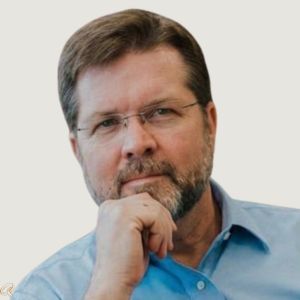
Brandon L. Blankenship is an assistant professor, continuing legal education presenter, and business educator. He and his wife Donnalee live on their hobby farm south of Birmingham, Alabama.
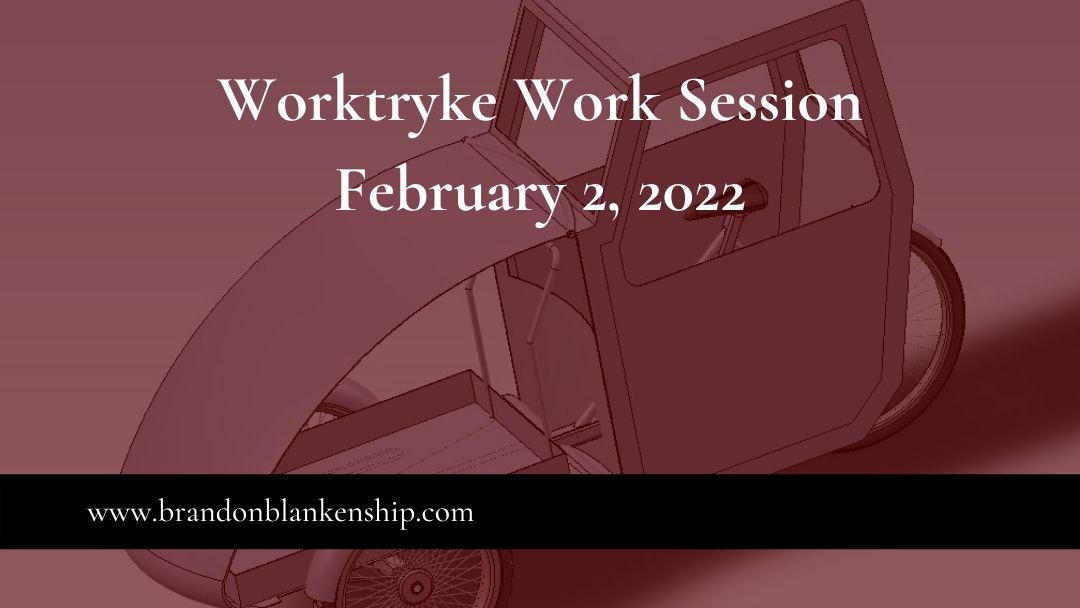
Once we started using SolidWorks to design a covering for the tray so that stuff could be carried safe from weather and theft AND design a windshield or cabin for the rider, the handlebars and steering presented a design concern. How do we steer the bike without crushing the rider's hand against the windscreen/ cabin? And, how do we design the cabin /windscreen so that the turning radius is not restricted to shallow turns?
So I have reached out to an engineer to help me think through this design challenge.
It does not make sense to go forward with fabrication or powder-coating until we can do all of the fabrication at once.
Brandon L. Blankenship is an assistant professor, continuing legal education presenter, and business educator. He and his wife Donnalee live on their hobby farm south of Birmingham, Alabama.
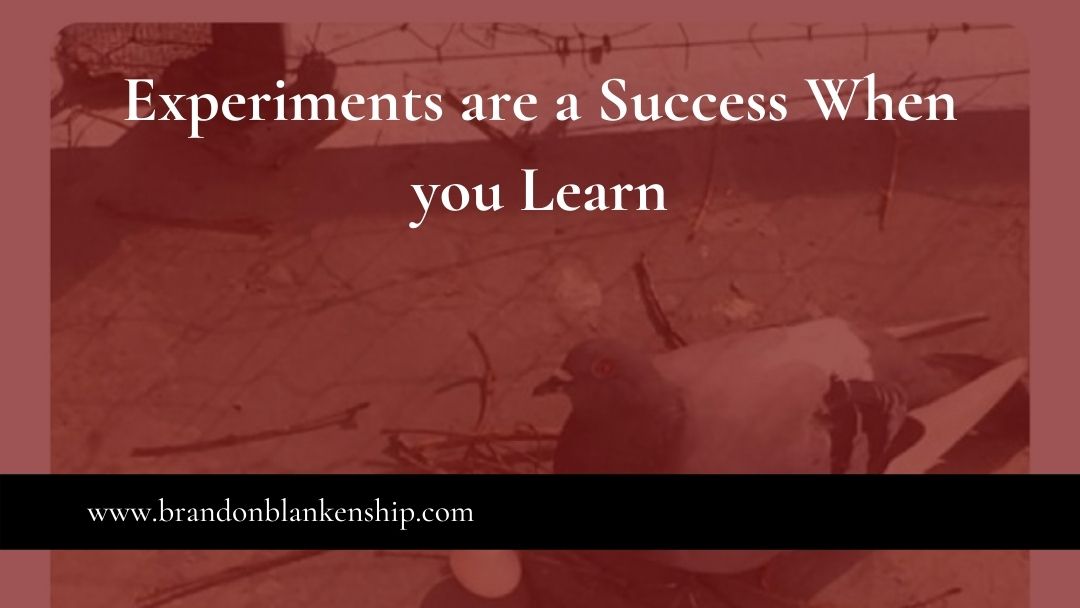
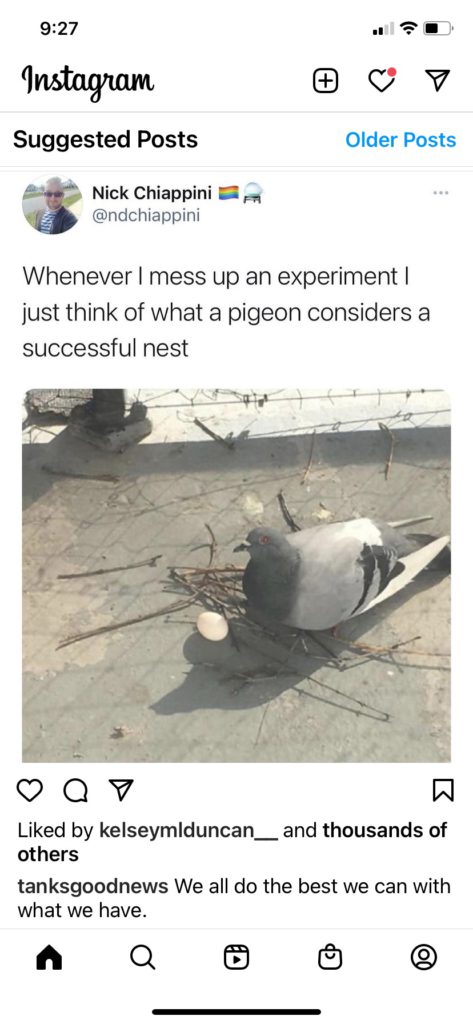
Someone shared this image with me of a pigeon's nest. I don't know if this accurately reflects the average pigeon's nest. I didn't google it. That isn't the point I took away from the image. The point I took away is that for an onlooker - like me - this nest looks like a failure. For the pigeon, it seems like a success. Success for me is when I learn.
I know many of my experiments look like a failure when folks look at them. Sometimes, they look like a failure -- after some time passes --- even to me. And I have to remind myself that because that experiment I know how to ______________________ (weld, plumb, research, cite, whatever). Success is when you learn.
Now that I have this image, I've got a reminder that what might look like a failed experiment might, in fact, be a success because I learned.
Brandon L. Blankenship is an assistant professor, continuing legal education presenter, and business educator. He and his wife Donnalee live on their hobby farm south of Birmingham, Alabama.
For many years, I got to know catastrophically injured people as their lawyer. What I mean by catastrophically injured people is people whose bodies were mangled when they were run over by 18-wheeler trucks, or people whose bodies were crushed when they were surprised by a construction defect or people who were burned over most of their body. Catastrophic.
What I mean by “got to know” is that over months or years, I was honored that clients shared their lives with me - and let me share my life with them. Part of this sharing was that I got to watch them heal or not heal over time.
A clear observation that I made over time was the clients who admitted to drinking alcohol healed slower. Clients who admitted to tobacco use did not heal.
Brandon L. Blankenship is an assistant professor, continuing legal education presenter, and business educator. He and his wife Donnalee live on their hobby farm south of Birmingham, Alabama.
"D" at Redemptive Cycles was good enough to talk with me about what I am imagining for the Worksman Trike. I'm calling this experiment the "Worktryke."
I understand that this trike was used in the Fairfield Still Works. This seems like a good experiment for Birmingham, Alabama. Take something from Birmingham's past and modernize it for 2021. This trike certainly has good bones. It is officially a Worksman Model U tricycle manufactured by the Worksman Cycles Company, Inc. in Ozone Park, NY. This company is the oldest bicycle manufacturer in the United States.
Conceptually, I imagine several upgrades to make this trike more useable for use in the city (as opposed to in a covered still mill). The trike was designed to carry a lot of weight, slowly. It would be useful to carry weight, but for urban use the trike has to move faster and not trap rain in the front tray. Moving faster may mean better brakes. Here is a bullet list of possible upgrades
Electric motor drive
Brakes to accommodate the faster speed
Windbreak to cover tray (maybe with a solar feature)
The next step seems to be to reach out to a metal fabricator and see what options there might be for adding tabs on the front and left right so that there would be a place to bolt the part of the disk brake that pinches the disk and slows the trike.
Brandon L. Blankenship is an assistant professor, continuing legal education presenter, and business educator. He and his wife Donnalee live on their hobby farm south of Birmingham, Alabama.
Today, I divide my work up into experiments and projects. I attribute this concept to Neville N. Medhora. I wish he had taught me sooner.
When I was growing up I was always puzzling on something - usually something way beyond my reach - to figure out. I took apart any electric or electronic device that I got my hands on. I wanted to know what was inside, what made them work. Sometimes, I got them back together. My dad called it piddling, which I heard to mean failure. Looking back, it was not failure at all. It was exerimenting and even when I couldn't get something back together or make it work again, the expermient was not a failure. Nor was it pathetically trivial or trifling (the actual meaning of piddling). To some degree it was a success because the intention was to puzzle and learn and I did.
So, today I break my work up into experiments and projects. The intention and end of an experiment is to puzzle on something and learn.
Projects are different. Once I classify something as a project, the intention is a finished deliverable, by a deadline, under budget. Projects are the "get after it" portion of my life.
This differentiation has helped me because I can now experiement without the stress of a budget or a deadline. I am experimenting for the sake of learning. Sometimes I can just take something apart, see what makes it work, and not even try to put it back together. I'm learning.
But once I classify something as a project, it has to get done and it has to work.
For me, that is the difference between an experiment and a project.
Brandon L. Blankenship is an assistant professor, continuing legal education presenter, and business educator. He and his wife Donnalee live on their hobby farm south of Birmingham, Alabama.