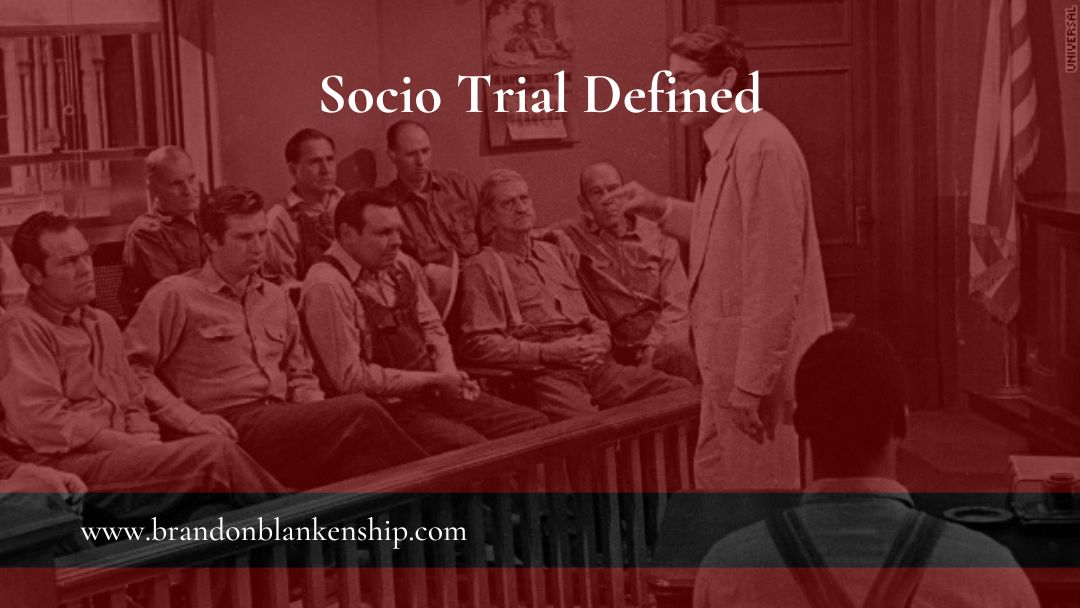
A Socio Trial is a community-based, participatory justice process inspired by J.L. Moreno’s sociodrama and designed to address persistent injustices—such as those rooted in racial or economic oppression—by transforming the traditional trial format into a vehicle for collective healing and social change. Unlike a mock trial, which simulates legal proceedings for educational purposes, or a show trial, which is orchestrated for spectacle and control, a Socio Trial is grounded in democratic, power-sharing principles and the belief that mutual understanding, empathy, and creative action are a catalyst for justice.
In a Socio Trial, community members gather not as adversaries, but as co-actors in a dramatized exploration of the injustices affecting their lives. Roles—such as those of the harmed, the accused, bystanders, and community leaders—are cast to reflect real social dynamics, with participants encouraged to step into each other’s experiences and perspectives. The process is guided by a director who ensures that the proceedings remain open, respectful, and focused on uncovering underlying values, beliefs, and systemic patterns that perpetuate harm.
Drawing from Moreno’s teachings, the Socio Trial leverages the power of surplus reality—the enactment of scenarios beyond the limits of everyday life—to allow participants to imagine new possibilities for justice and reconciliation. The aim is not to assign blame or deliver punitive verdicts, but to surface collective lived experiences, foster empathy, and co-create actionable solutions that can repair relationships and transform the community’s social fabric.
Ultimately, a Socio Trial is a living, evolving practice of justice that invites communities to move beyond the “dead past” of entrenched oppression and toward a more thriving future—one in which every voice is heard, and every member is empowered to participate in the healing of the whole.
Augusto Boal Would Have Supported
It is highly likely that Augusto Boal would have been in favor of the concept of a Socio Trial. Boal’s Theatre of the Oppressed was explicitly designed to empower communities to analyze, dramatize, and transform their own realities, using participatory theatrical forms where audience members become “spect-actors” who actively intervene, propose solutions, and rehearse social change.
A Socio Trial, grounded in sociodrama and aimed at resolving persistent injustices through collective enactment and dialogue, aligns closely with Boal’s vision of theatre as a rehearsal for real-world transformation and liberation. He believed that theatre should not be a spectacle for passive consumption but a democratic space for critical reflection, dialogue, and the co-creation of new possibilities for justice and equity.
Boal’s methods—such as Forum Theatre and Legislative Theatre—were specifically developed to address oppression, foster empathy, and give marginalized communities tools to reshape social structures. A Socio Trial, as a participatory, justice-oriented process, would embody these principles by enabling communities to confront and resolve systemic injustices together, making it a natural extension of Boal’s legacy.
And Paula Freire Would Have Agreed
Paulo Freire would have almost certainly be in favor of the concept of a Socio Trial. Freire’s critical pedagogy centers on dialogue, collective problem-solving, and the co-creation of knowledge to challenge and transform structures of oppression. He rejected traditional, hierarchical models of education in favor of “problem-posing” approaches, where teachers and learners engage as equals to critically examine their lived realities and take action toward emancipation from injustice.
A Socio Trial, grounded in participatory drama and aimed at resolving persistent community injustices, embodies these principles: it invites all participants to share their experiences, reflect on power dynamics, and collaboratively imagine solutions. This process not only raises critical consciousness (conscientização) but also turns reflection into praxis—collective action for social transformation. Freire believed that education and justice are never neutral, and that true liberation comes from processes forged “with, not for, the oppressed.” Thus, a Socio Trial would align closely with Freire’s vision of humanizing, dialogical, and transformative justice.
For further reading:
- Anchor, R. (1967). The enlightenment tradition. California: University of California Press
- Aron, L. (1996). A meeting of minds: Mutuality in psychoanalysis. Hillsdale NJ: The Analytic Press.
- Bagnall, R. G. (1999). Discovering radical contingency: Building a postmodern agenda in adult education. New York: Peter Lang.
- Baim, C., Burmeister, J. & Marciel, M. (2007). Psychodrama: Advances in theory and practice. East Sussex: Routledge.
- Berne, E. (1970). Review of gestalt therapy verbatim by F. Perls (1969). American Journal of Psychiatry, 10, 163-164.
- Blatner, A. (2004). Foundations of psychodrama (4th Edition). New York: Springer
- Blatner, A. (June, 2007). Meta-theoretical perspectives on psychodrama. In C. Baim, J. Burmeister & M. Maciel (Eds.), Psychodrama: Advances in theory and practice (pp 5-20). London: Routledge.
- Boal, Augusto. Theatre of the Oppressed. Translated by Charles A. McBride. New York: Theatre Communications Group, 1993.
- Bromberg, P. M. (1998). Standing in the spaces: Essays on clinical process, trauma, and dissociation. Hillsdale NJ: Analytic Press.
- Fleury, H. J. & Knoble, A. M. (2011). The concept of the co-unconscious in Moreno’s psychodrama. In E. Hopper & H. Weinberg (Eds.) The social unconscious in persons, groups, and societies, volume 1: Mainly theory (pp. 23-44). London: Karnac.
- Freire, Paulo (2005). Pedagogy of the Oppressed. New York, London: continuum.
- Hare A. P. & Hare, J. R. (1996). J. L. Moreno. London: Sage.
- Holmes, P., Karp, M. & Watson, M. (Eds.). (1994). Psychodrama since Moreno. London: Routledge.
- Kipper, D. A. (1988). On the definition of psychodrama: Another view. Journal of Group Psychotherapy, Psychodrama & Sociometry, 40(4), 164-168.
- Karp, M., Holmes, P., & Bradshaw Tauvon, K. (1998). The Handbook of Psychodrama. New York: Routledge.
- Kipper, David A. (1997). Classical and contemporary psychodrama: A multifaceted, action-oriented psychotherapy. International Journal of Action Methods: Psychodrama, Skill Training, and Role Playing, 50(3), 99-107.
- Kellerman, P. F. (1987). A proposed definition of psychodrama. Journal of Group Psychotherapy, Psychodrama & Sociometry, 40(2), 76-80.
- Kellerman, P. F. (1992). Focus on psychodrama. London: Jessica-Kingsley.
- Maslow, A. H. (1968). Towards a psychology of being (3rd ed). Canada, Wiley & Sons.
- Maslow, A. H. (1968). Letters to the editor. LIFE Magazine, August 2,
- Moreno, J. L. (1945). Who shall survive: Foundations of sociometry, group psychotherapy and sociodrama. New York: Beacon House.
- Moreno, J. L. (1994). Psychodrama first volume (4th ed reprint). McLean VA: American Society for Group Psychotherapy& Psychodrama.
- Moreno, J. l . (2011). The theatre of spontaneity (4th ed). U.K.: North-West Psychodrama Association.
- Moreno, J. L. (1955). Preludes to my autobiography, New York: Beacon House.
- Moreno, J. L. (Ed.) (1956). Sociometry and the science of man New York: Beacon House.
- Moreno, J. L. (2011). The autobiography of J. L. Moreno (abridged), U.K.: North-West Psychodrama Association.
- Moreno, J. L. & Moreno, Z. T. (1975). Psychodrama , second volume (2nd ed). New York: Beacon House.
- Moreno, J. L. & Moreno, Z. T. (1969). Psychodrama third volume. New York: Beacon House.
- Nolte, J. (2008). The psychodrama papers. Connecticut: Encounter Publications.
- Phillips, D. C. (2000). Constructivism in education. Opinions and second opinions on controversial issues. Ninety-Ninth Yearbook for the National Society for the Study of Education. Chicago: University of Chicago Press.
- Oudijk, R. (2007). A postmodern approach to psychodrama theory. In C. Baim, J. Burmeister & M. Maciel (Eds.), Psychodrama: Advances in theory and practice (pp 139-150). London: Routledge.
- Rorty, R. (1982). Consequences of pragmatism. Minnesota: University of Minnesota Press.
- Scheiffele, E. (1995). The theatre of truth: Psychodrama, spontaneity and improvisation: The theatrical theories and influences of Jacob Moreno. Berkely: University of California.
- Schutz, W. (1971). Here comes everybody. New York: Harper and Row.
- Sprague, K. (1994). Time, space, reality and the cosmos: the four universals of Moreno’s philosophy. In P. Holmes, M. Karp & M. Watson (Eds.), Psychodrama since Moreno (pp. 6-26) London: Routledge.
- Usher, R., Bryant, I. & Johnston, R. (1997). Adult education and the post modern challenge: Learning beyond the limits. London: Routledge.
- Williams, A. (1989). The passionate technique. London: Routledge.
- Yalom, I. (2005). Theory and practice of group psychotherapy (5th ed). New York: Basic Books